
From term papers to bunkers
Will AI help an elite phoenix rise from its ashes?
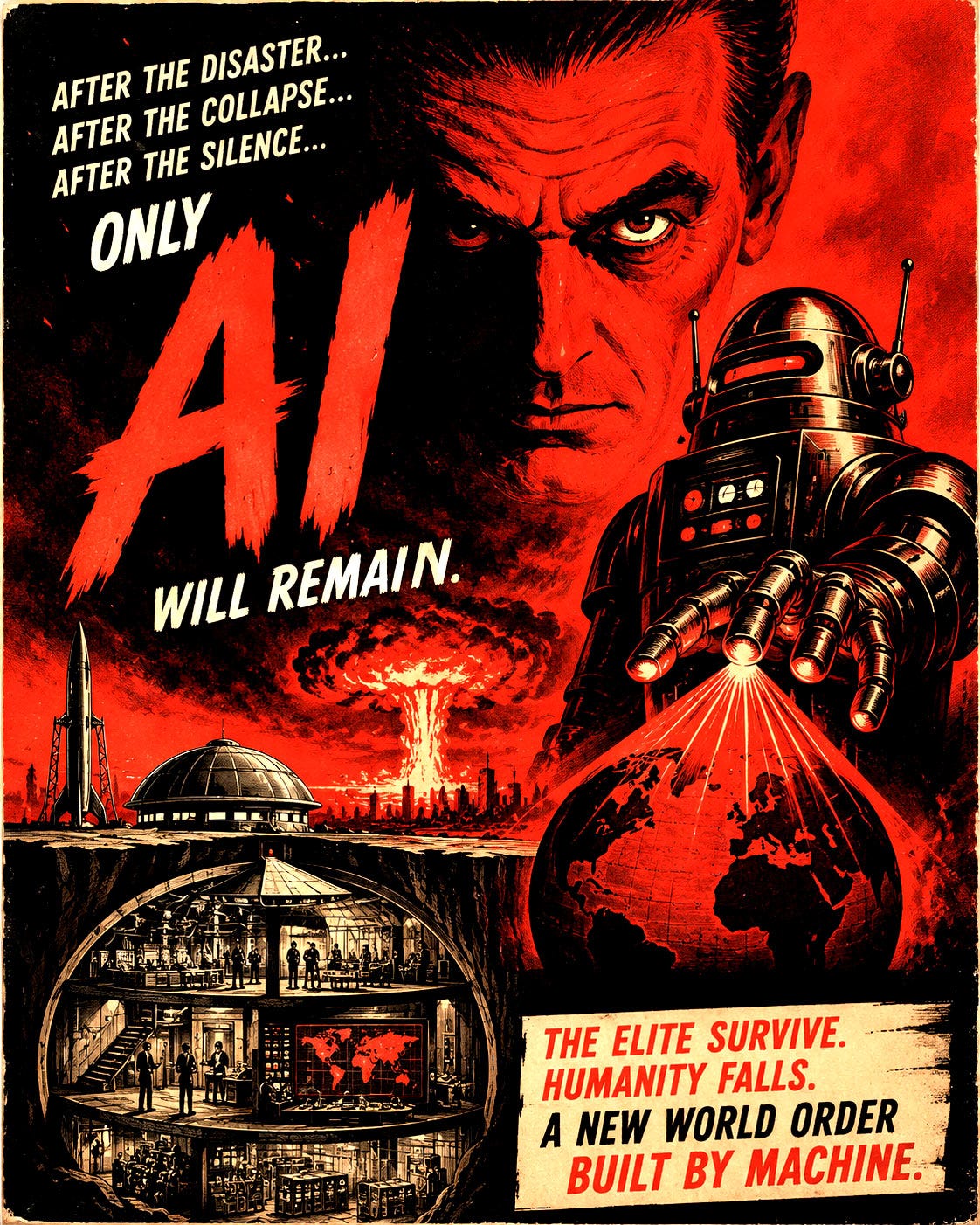
A few years ago, artificial intelligence posed a grave threat to civilization. Or so I was told.
Students would use it to cheat on term papers.
Professors would never know whether a freshman had written an essay on “The Great Gatsby” or whether a chatbot had done the work. School systems would collapse, higher education would descend into chaos, and civilization would demand Soykent Green.
At least, that was the fear.
I’ve always enjoyed watching fringe YouTube channels. According to them, we’ve moved well beyond concerns about book reports. AI is now part of a sprawling plan in which global elites retreat to luxury bunkers during a coming catastrophe that wipes out 75 percent of humanity. Once the dust settles, artificial intelligence will help them rebuild society and rule what’s left of us.
It’s quite a leap in two years.
The funny thing is that every generation seems to invent new technology but recycle the same fears.
In the 1950s, people worried that computers would create a technocratic dictatorship. Later came fears about population collapse, resource depletion, black helicopters, FEMA camps, RFID chips, and social-media mind control. Today’s anxiety machine has simply bolted AI onto the front of the train.
Part of the problem is that AI remains mysterious to most people. Nearly everyone has some sense of how a car works. Press the accelerator, gasoline burns, the wheels turn. Artificial intelligence operates behind a curtain. The less understood a technology becomes, the easier it is to imagine that it possesses unlimited power.
And to be fair, some of the raw ingredients in these stories are real.
Data centers consume enormous amounts of electricity. Governments use surveillance technology. Wealthy people buy extravagant compounds and, in a few cases, even bunkers. AI systems grow more capable every year.
The leap comes when those disconnected facts get stitched into a single grand narrative.
Human beings love stories. We crave plots. We want villains, heroes, secret plans, and hidden motives. A thousand unrelated developments are unsatisfying. A conspiracy ties everything together with a neat bow.
Reality rarely cooperates.
Most AI development today looks less like “The Terminator” and more like a corporation trying to automate customer support, write marketing copy, sort invoices, or help programmers crank out code faster. It’s not nearly as cinematic.
The latest conspiracy videos also spend a lot of time warning about “15-minute cities,” a phrase that sounds as though it escaped from a dystopian science-fiction novel. Yet strip away the label and the concept often boils down to this: Wouldn’t it be nice if a grocery store, microbrewery, pharmacy, restaurant, and park were close to where you live?
That’s hardly the opening chapter of “Nineteen Eighty-Four.”
What strikes me most is how quickly the public imagination shifts. Yesterday’s existential threat was a teenager using ChatGPT to write a history paper. Today’s is an AI-controlled civilization rising from the ruins after an engineered apocalypse.
Ten years from now, we’ll probably laugh at some of today’s predictions the way we laugh at old magazine covers promising flying cars in every driveway or a household nuclear reactor in every basement.
A few fears will prove justified. Others won’t. Reality has a habit of disappointing both the prophets and the doomers.
And if history is any guide, the future will be far stranger — and far more ordinary — than either side expects.